Posts

Love

Love is a tricky concept, especially when using it to define the existence of characters in a time so different from ours. For the most part of this novel, love has been more of a forced burden. The rose petals, one of the most definite symbols of love, were sewn and not authentic; Milkman, the only son of Ruth, watched from afar as his mother was strangled and he chose to ignore reality. In cases where love truly blooms, it is quickly vanquished by another in fear of what it could lead to. When Macon Dead Jr. found out about the nature of the relationship between Corinthians and Porter, he immediately did everything in his power to end it.             However, in the case where love was meant to be pure, we quickly dismissed it and labeled it as hatred instead. Guitar committed his acts of murder out of “love” for “us,” not for “hating white people,” as he repeatedly told Milkman (Morrison 159). Later on, after Guitar attempted...
What I Found Interesting in Song of Solomon

Throughout the Song of Solomon , Toni Morrison conveys a mass amount of detail and description in such a way that the reader is forced to analyze all the content to find the hidden clue and understand the deeper meaning. It was interesting to me how she represented what America was to blacks and the underprivileged at the time. The hospitals and snow, “both white,” “red velvet rose petals,” and “wide blue wings,” all are meant to represent the American flag (Morrison 5,6). As Mr. Smith dies, a woman goes into labor; symbolizing for life to begin, death must happen first. Ultimately, although I was originally confused with why Mr. Smith’s character was even introduced, I later understood that at the time, blacks only had a limited amount of “freedom” among them, and they had to sacrifice whatever they had to get more. I also found the list of names particularly interesting. Morrison went down the family line, and repeated Dead after the names. As we read aloud the list in class, inste...

Violence in Text, Film, and Pictures

It is the “responsibility” of the free press to provide as much non-filtered information as possible, specifically regarding violent images, without consideration of whether the people will care for the information, or what they will think of it (Source B). I specifically want to talk about one of my body paragraphs from the essay. I’m not going to write the body paragraph here but explain the key points that I hopefully conveyed in the actual essay. Before reading Maus , we read a comic which explained the co-dependence of images and text. There were varying levels, but nonetheless, both images and text could represent the same idea but offer an even greater understanding to the reader if used together in the appropriate manner. Thus, if a violent image depicts something, then text could do the exact same. When we read The Things They Carried , there were no images, yet all the gory visuals that could have been given to the audience in the form pictures were rather given by textua...

Smoke and Conversation

Image
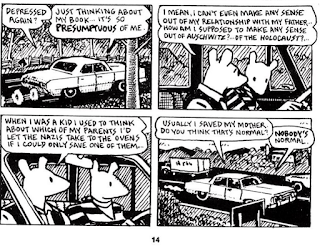
            The series of panels I chose are the four lowest panels on page fourteen in Maus Volume 2. I specifically want to draw attention to the conversation taking place between Art and Francoise along with the smoke coming out of the car. Art and his wife are talking about the lack of understanding Art has about Auschwitz and the experience his father went through. The conversation then, rather dramatically, transforms into one where Art confesses he would rather prefer his mother live and his father die in the Nazi’s gas chambers. In my opinion, as Art is having difficulty understanding the torture and pain the Jews went through during the Holocaust, he is, probably subconsciously, trying to connect the infamous events that took place during the Holocaust with his personal feelings about his family just to get a better sense. Since both of his parents underwent the Holocaust, Art transfers his direct frustration with his fa...

Are Comics Only For Kids?

     This week in class we read, Show and Tell by Scott McCloud. I have never been a big enthusiast on comics or even books with pictures. Sure, there once was a time when I literally refused to even touch a book without any pictures, but as McCloud said, I had to “grow out of it” just like everybody else. After reading this piece, however, I started thinking about why I had to give up books with pictures, in particular, comics. The main objective of solely text-based books, which was slightly discussed in class, is to allow the reader to freely visualize the context with the descriptions fitted by the author. I don’t really have an issue with this, but sometimes authors just fill their books with complex sentences and situations, and diction which is hardly ever used by anyone just so they can express their sophistication. Just understanding the work by some of these authors is a challenge in itself, but then having to use my imagination to actually picture the context...

"Civil Disobedience" and Today

     At first glance, there may seem to be a large discrepancy between today’s America and our government, and those which Henry David Thoreau describes in Civil Disobedience . However, the chasm is not as large as one may think. Yes, Americans may be more outspoken today, either for better or worse, but that does not necessarily mean they are more free from government. Rather, it can be argued we are more chained to government than we would like to believe so. One sole question now persists, why is this the case? The short answer is because we let the government get too large.      Now for the lengthier, more complicated answer. There is only a limited amount of freedom that an individual can have. The most amount of freedom is in an anarchist society and the least is in a society engulfed by communism. In other words, the more control the government has, the less freedom the individuals have. So why don’t we live in an anarchist society? This society ...

My Analysis on "This Is Water"

     In my personal opinion, David Foster Wallace’s This is Water is the most relatable and overall useful piece we have read so far in class. The general concept Wallace spends about five pages explaining is how to look at the larger picture and not always imagine the world revolves around yourself. He mentions how we are all inherently self-centered and it is only natural human tendency to think about how others impact our lives specifically rather than thinking about how society runs as a whole and the different situations others may be in. “Basic self-centeredness… It is our default setting, hard-wired into our boards at birth” (Wallace 233). This idea in itself is not new, as even one of the most fundamental principles of economics is that all of mankind will act selfishly, but the way it is examined throughout the piece causes the audience to ponder over what they just read and recognize its truthfulness.      Later in the piece, he claims how tr...